I hadn't planned on posting many photos from my holidays because this is a sewing blog after all and looking at other people's holiday snaps can get a little boring! But in the comments to the last post AllisonC asked for more photos and I finally finished sorting through them all, so here are a few photos of the key spots I went to in Nepal.
Kathmandu City
Kathmandu is pretty much like any other third world major city I've been in - it's noisy, smelly, dirty and extremely built up with little green space. It's also spread out over a very large area so it takes forever to travel from one side of the city to another. It's probably the town planner in me, but I found the maze of back streets, the jumble of land uses and hodge podge of built forms so fascinating.


There are lots of religious sites in the city, with small alters and shrines on nearly every corner. The Boudhanath Stupa is a large Buddhist site with one of the largest stupas in the world. It was severely damaged in the 2015 earthquake but has since been rebuilt. Buddhists visiting this site walk around in a clockwise direction turning the prayer wheels while chanting.


Pashupatinath Temple on the other hand is a Hindu site which is a very large complex comprising temples, spaces for cremations and a hospice. The cremations are carried out alongside the river in a very open and public fashion - on one side of this river there were crowds of tourists watching and taking photos whilst on the other side of the river were grieving families preparing bodies openly and funeral pyres alight cremating the bodies. It was quite morbid and completely different to the very private manner in which we deal with death in western society.

The after effects of the devastating 2015 earthquake are still highly visible everywhere in the city. Rebuilding work is occurring on the main heritage sites in the city with financial assistance from foreign governments, but work is progressing slowly.

Everest Base Camp Trail
To start the trail to Everest Base Camp, you first fly in a small aircraft to Lukla airport which is one of the most dangerous airports in the world. The runway is very short, steep and ends abruptly with a stone wall - if you google Lukla airport landings you'll see many plane crashes! Luckily my flights in and out were fine. The terminal itself is quite basic, and essentially when your plane arrives you get the signal to run out and get on the plane as fast as you can - there is such a turn around in planes that there's no time to hang about.


The town of Lukla is one main street with shops selling hiking equipment, lodges and cafes. The animals in Lukla give new meaning to a traffic jam though!


The Everest Base Camp trail is quite busy and I wasn't even there in peak season. The trail is rocky, dusty and pretty much steeply up or down at all times. It's usually referred to as the national highway, because on this trail are the hikers, porters carrying immense loads, donkeys, dzopkos (cow cross yak) and yaks in the higher altitude only because the yaks get too hot lower down.


The trail crosses the Dudh Kosi river many times, each time across long suspension bridges that get higher and higher above the river the along the trail you get. Everyone crosses these bridges, including the animals!


Funnily enough you can only get glimpses of Mt Everest here and there along the trail. Even though it's the highest peak in the world, from the Nepalese side it's hidden behind other mountains so you mostly only see the very top of it and it's usually hidden behind cloud from late morning onwards as well!

Everest Base Camp
The hike to Base Camp starts in a village called Gorek Shep which frankly was an awful place. The septic system in our lodge had frozen over so we had to use the town drop toilets which was far from pleasant, and when the sun went down it got absolutely freezing. Apparently 15 or so years ago there used to be a lake in Gorek Shep, but now it's this big sandy space you can see in the photo below.


Base Camp itself is completley underwhelming. It's literally that litte hump in the photo below - you have to walk through miles of rock and ice just to get to it and outside of climbing season there isn't anything there except a spot to take a photo! The Khumbu Icefall behind the camp is the start of the Everest climb and apparently is extremely dangerous to cross. And you can't even see Mt Everest from here because it's hidden behind the Western Cwm and other peaks.

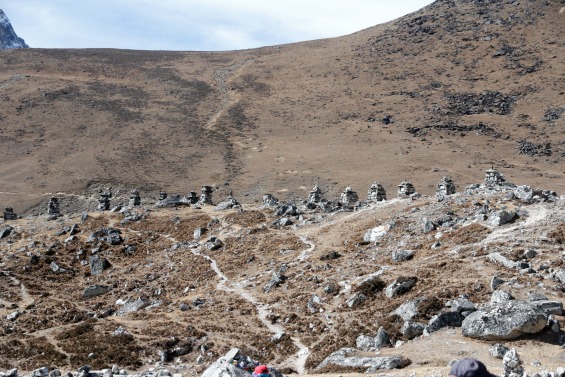
Along the trail there is a particular site with memorials to the many people that have died attempting to climb Mt Everest - both the Sherpas and foolhardy westerners. Those planning to climb Mt Everset have to walk past this but even that is not enough to put them off I guess judging the by the numbers that attempt each year. The photos below show the simple stone stacks for the Sherpas, and the more elaborate monuments to the foreign climbers.

Namche Bazar
Enroute to Base Camp is the large village of Namche Bazar. Everyone stops here for at least a day on the way up to acclimatise, and the village is quite bustling with cafes, bars and shops. It is literally built on the side of a mountain so there are steep stairs everywhere and it's not very easy to get from the bottom to the top!


On my returnn trip we stopped in Namche Bazar for another night. By this stage it had been about 18 days since I had showered or washed my hair (we just had bowls of hot water each day to do "washy washy"of the important parts), so when I spied a hairdressing salon I simply had to try it out. I felt amazing after a wash and blowdry!

Gokyo Lakes
The main route to Base Camp goes straight there from Lukla, but the trek I went on detoured off to the east to a more remote part to travel through the amazingly beautiful Gokyo Lakes. The lakes are such a deep turquoise blue, surrounded by rocky mountains and snowy peaks - these photos and my words just cannot depict how beautiful it was. This was definitely the highlight of my trip, even if ascending to the top of Gokyo Ri was physically exhausting.


My accommodation on most of the trek was in tents, which were actually quite comfortable, clean and warmish. In Gokyo though we stayed in a teahouse which like most of them was really cold and with paper thin walls I could hear every cough, vomit and explosive bowel movement of the other guests. Yes it was really gross. In this teahouse, my drink bottle that was full of hot water at bedtime had frozen solid by the morning it was that cold!


Cho La Pass
To get from Gokyo Lakes area back over to the Everest Base Camp trail we had to cross the Cho La Pass, which essentially is up and over the lowest part of the mountain range. The ascent involved scrambling up loose gravel and large boulders, almost vertically in places, in the hot sun whereas the other side meant climbing down ice and rock and crossing a large snow field in the freezing cold! The trail meandered off far into the distance so this was a very long and very tiring day.


Of course there were prayer flags marking the peak - they were the signal that you had reached the top and the hardest bit was behind you.


Chitwan National Park
After I finished the trek and spent a day in Kathmandu recovering, I headed down to the Chitwan National Park. This is the complete opposite of the Himalaya region - it's pretty flat, warm and humid and jungle like. I went on a jeep safari and spotted elephants, rhinoceros, crocodiles, birds and monkeys but not any tigers.


So that's Nepal in a nutshell. Even though I spent four weeks there and went from one extreme of the country to another I still feel like there is so much more to see.


Kathmandu City
Kathmandu is pretty much like any other third world major city I've been in - it's noisy, smelly, dirty and extremely built up with little green space. It's also spread out over a very large area so it takes forever to travel from one side of the city to another. It's probably the town planner in me, but I found the maze of back streets, the jumble of land uses and hodge podge of built forms so fascinating.
There are lots of religious sites in the city, with small alters and shrines on nearly every corner. The Boudhanath Stupa is a large Buddhist site with one of the largest stupas in the world. It was severely damaged in the 2015 earthquake but has since been rebuilt. Buddhists visiting this site walk around in a clockwise direction turning the prayer wheels while chanting.
Pashupatinath Temple on the other hand is a Hindu site which is a very large complex comprising temples, spaces for cremations and a hospice. The cremations are carried out alongside the river in a very open and public fashion - on one side of this river there were crowds of tourists watching and taking photos whilst on the other side of the river were grieving families preparing bodies openly and funeral pyres alight cremating the bodies. It was quite morbid and completely different to the very private manner in which we deal with death in western society.
The after effects of the devastating 2015 earthquake are still highly visible everywhere in the city. Rebuilding work is occurring on the main heritage sites in the city with financial assistance from foreign governments, but work is progressing slowly.
Everest Base Camp Trail
To start the trail to Everest Base Camp, you first fly in a small aircraft to Lukla airport which is one of the most dangerous airports in the world. The runway is very short, steep and ends abruptly with a stone wall - if you google Lukla airport landings you'll see many plane crashes! Luckily my flights in and out were fine. The terminal itself is quite basic, and essentially when your plane arrives you get the signal to run out and get on the plane as fast as you can - there is such a turn around in planes that there's no time to hang about.
The town of Lukla is one main street with shops selling hiking equipment, lodges and cafes. The animals in Lukla give new meaning to a traffic jam though!
The Everest Base Camp trail is quite busy and I wasn't even there in peak season. The trail is rocky, dusty and pretty much steeply up or down at all times. It's usually referred to as the national highway, because on this trail are the hikers, porters carrying immense loads, donkeys, dzopkos (cow cross yak) and yaks in the higher altitude only because the yaks get too hot lower down.
The trail crosses the Dudh Kosi river many times, each time across long suspension bridges that get higher and higher above the river the along the trail you get. Everyone crosses these bridges, including the animals!
Funnily enough you can only get glimpses of Mt Everest here and there along the trail. Even though it's the highest peak in the world, from the Nepalese side it's hidden behind other mountains so you mostly only see the very top of it and it's usually hidden behind cloud from late morning onwards as well!
Everest Base Camp
The hike to Base Camp starts in a village called Gorek Shep which frankly was an awful place. The septic system in our lodge had frozen over so we had to use the town drop toilets which was far from pleasant, and when the sun went down it got absolutely freezing. Apparently 15 or so years ago there used to be a lake in Gorek Shep, but now it's this big sandy space you can see in the photo below.
Base Camp itself is completley underwhelming. It's literally that litte hump in the photo below - you have to walk through miles of rock and ice just to get to it and outside of climbing season there isn't anything there except a spot to take a photo! The Khumbu Icefall behind the camp is the start of the Everest climb and apparently is extremely dangerous to cross. And you can't even see Mt Everest from here because it's hidden behind the Western Cwm and other peaks.
Namche Bazar
Enroute to Base Camp is the large village of Namche Bazar. Everyone stops here for at least a day on the way up to acclimatise, and the village is quite bustling with cafes, bars and shops. It is literally built on the side of a mountain so there are steep stairs everywhere and it's not very easy to get from the bottom to the top!
On my returnn trip we stopped in Namche Bazar for another night. By this stage it had been about 18 days since I had showered or washed my hair (we just had bowls of hot water each day to do "washy washy"of the important parts), so when I spied a hairdressing salon I simply had to try it out. I felt amazing after a wash and blowdry!
Gokyo Lakes
The main route to Base Camp goes straight there from Lukla, but the trek I went on detoured off to the east to a more remote part to travel through the amazingly beautiful Gokyo Lakes. The lakes are such a deep turquoise blue, surrounded by rocky mountains and snowy peaks - these photos and my words just cannot depict how beautiful it was. This was definitely the highlight of my trip, even if ascending to the top of Gokyo Ri was physically exhausting.
My accommodation on most of the trek was in tents, which were actually quite comfortable, clean and warmish. In Gokyo though we stayed in a teahouse which like most of them was really cold and with paper thin walls I could hear every cough, vomit and explosive bowel movement of the other guests. Yes it was really gross. In this teahouse, my drink bottle that was full of hot water at bedtime had frozen solid by the morning it was that cold!
Cho La Pass
To get from Gokyo Lakes area back over to the Everest Base Camp trail we had to cross the Cho La Pass, which essentially is up and over the lowest part of the mountain range. The ascent involved scrambling up loose gravel and large boulders, almost vertically in places, in the hot sun whereas the other side meant climbing down ice and rock and crossing a large snow field in the freezing cold! The trail meandered off far into the distance so this was a very long and very tiring day.
Of course there were prayer flags marking the peak - they were the signal that you had reached the top and the hardest bit was behind you.
Chitwan National Park
After I finished the trek and spent a day in Kathmandu recovering, I headed down to the Chitwan National Park. This is the complete opposite of the Himalaya region - it's pretty flat, warm and humid and jungle like. I went on a jeep safari and spotted elephants, rhinoceros, crocodiles, birds and monkeys but not any tigers.
So that's Nepal in a nutshell. Even though I spent four weeks there and went from one extreme of the country to another I still feel like there is so much more to see.